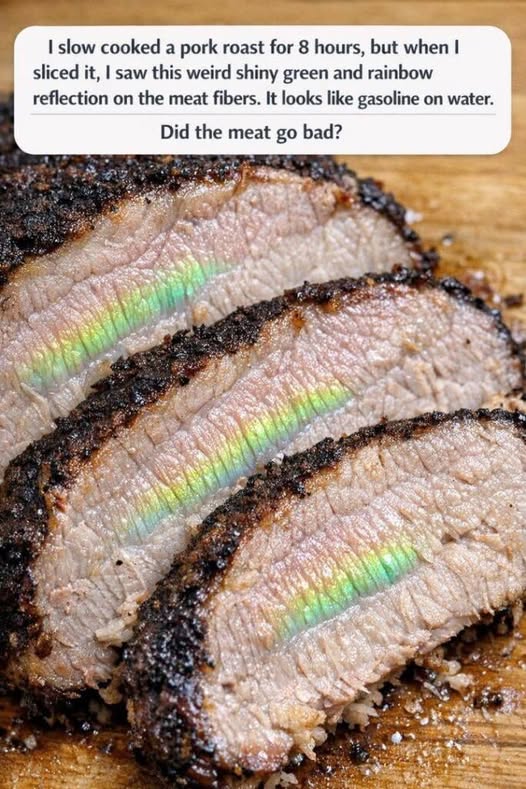
You slow-cooked a pork roast for eight hours. The kitchen smelled amazing. The meat was tender. Everything seemed perfect — until you sliced into it.
Suddenly, you notice something strange.
A shiny green or rainbow reflection across the surface of the meat. It almost looks like gasoline shimmering on water. Your appetite disappears instantly.
Did it go bad? Is it spoiled? Is it safe to eat?
Before you throw away that entire roast, take a deep breath. In most cases, that rainbow effect is completely normal — and it has a fascinating scientific explanation.
The Rainbow Effect in Cooked Pork: It’s Called Iridescence
What you’re seeing is known as iridescence — a natural optical effect that happens when light reflects off certain surfaces in a specific way.
You may have seen iridescence before on:
-
Soap bubbles
-
Oil slicks on pavement
-
Peacock feathers
-
CDs or DVDs
In meat, the same visual phenomenon can occur under the right conditions.
And surprisingly, it has nothing to do with spoilage.
Why Does Pork Show Green or Rainbow Colors?
Pork contains muscle fibers arranged in a highly organized structure. When you cook the meat and slice it across the grain, the cut surface can reflect light in different directions.
Here’s what happens:
-
Light hits the cut surface of the meat.
-
The organized muscle fibers act like tiny prisms.
-
The light waves scatter and interfere with each other.
-
Certain wavelengths are amplified — often green or rainbow tones.
This creates that metallic, gasoline-like shimmer.
It’s a trick of light — not a sign of bacteria or decay.
Is It Safe to Eat?