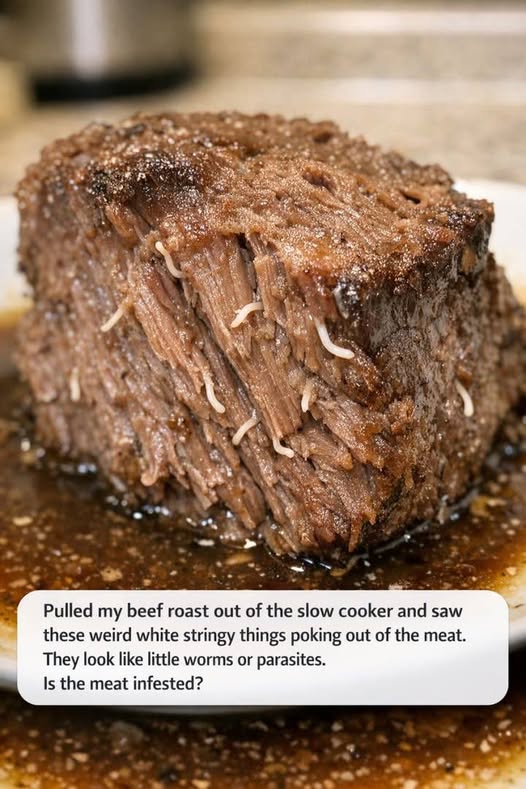
Budget-friendly roasts like chuck are popular for slow cooking because they’re flavorful and become incredibly tender over time.
But these cuts contain more connective tissue — which is why they require slow cooking in the first place.
As collagen melts into gelatin, it gives you that juicy, melt-in-your-mouth texture.
Some strands may remain visible — and while they can look unusual, they’re completely edible.
Many people actually trim them away after cooking for texture preference, not safety reasons.
🤔 Why It Looks So Disturbing
Our brains are wired to react quickly to anything that resembles worms or parasites. It’s a survival instinct.
When we see something stringy and pale in food, it triggers that alarm system.
But context matters.
Cooked muscle fibers and connective tissue can take on unexpected shapes — especially when shredded.
It’s appearance, not danger.
🧑🍳 When Should You Actually Worry?
There are only a few situations where further investigation might be needed:
-
The meat had a foul odor before cooking
-
The packaging was damaged or leaking
-
The color was abnormal when raw
-
The meat was undercooked
If none of these apply, and the roast tasted and smelled normal, there is little reason for concern.
When in doubt, trust your senses.
🥘 The Bottom Line