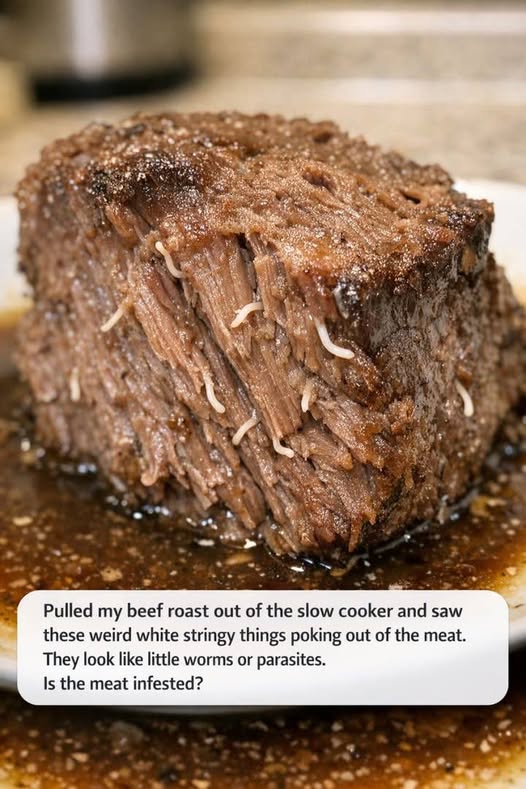
You know that feeling when you’ve been waiting all day for a comforting, slow-cooked beef roast… and then the moment you lift it out of the pot, something doesn’t look right?
That’s exactly what happened.
The meat was tender. The aroma was perfect. But as I pulled the roast apart, I noticed strange white stringy things poking out of the beef. They looked thin. Pale. Almost like little worms.
My stomach dropped.
Had I just cooked something unsafe? Was it contaminated? Were these parasites?
If you’ve ever had this experience, you’re not alone. It’s surprisingly common — and fortunately, the explanation is far less frightening than it first appears.
Let’s break down what’s really going on.
🥩 The Most Common Cause: Connective Tissue
Those white stringy strands you’re seeing are almost always connective tissue.
Beef roasts — especially cuts like chuck, shoulder, or round — are full of collagen and other connective fibers. These tissues help hold the muscle together while the animal is alive.
When you cook beef low and slow, especially in a slow cooker:
-
Collagen breaks down gradually
-
Muscle fibers soften
-
The meat becomes tender enough to shred
However, not all connective tissue dissolves completely. Some of it remains visible as thin, pale strands.
When the roast is pulled apart, these strands can stick out — creating a surprisingly worm-like appearance.
But they are simply part of the meat’s natural structure.
🔥 Why Slow Cooking Makes It More Noticeable